How Long Does Home Canned Food Last?
Here is the honest answer, up front: home-canned food that was processed correctly, sealed correctly, and stored well keeps its best quality for about 1 year. That is the guidance from the National Center for Home Food Preservation (NCHFP), and it is a quality rule before it is anything else. Safety rides on the seal staying intact — a jar whose seal has held, with no signs of spoilage, is a different question from a jar whose seal has failed. Quality is what fades on schedule: colour dulls, texture softens, flavour flattens, and nutrients decline, month by month, even in a perfect cupboard. So the practical rule for a home canner is simple to say and worth organising your shelves around: can no more than you will use within a year, store every jar as well as you can, and let the oldest jars move to the front.
The Best-Quality Window, Explained
The 1-year window is not an expiry date. A jar does not turn from good to bad on a single morning. The year describes how long a well-made jar, kept in good conditions, stays close to what you put into it. Beyond it you are increasingly eating the storage, not the harvest: peaches that have lost their brightness, beans gone soft past pleasant, tomatoes whose fresh edge has left them.
That is why the advice is a planning rule — can what you will use within a year — rather than a dare about how long a seal can hold. A glorious surplus eaten slowly over several years is not a triumph of preserving; it is a slow slide into mediocrity. Smaller batches, canned in step with how your household actually eats, beat one heroic canning weekend every time. And the year assumes the seal is intact — something you verify, not presume. A jar well within its year still needs throwing out if the seal has broken or spoilage signs are present.
Storage Conditions That Protect Your Jars
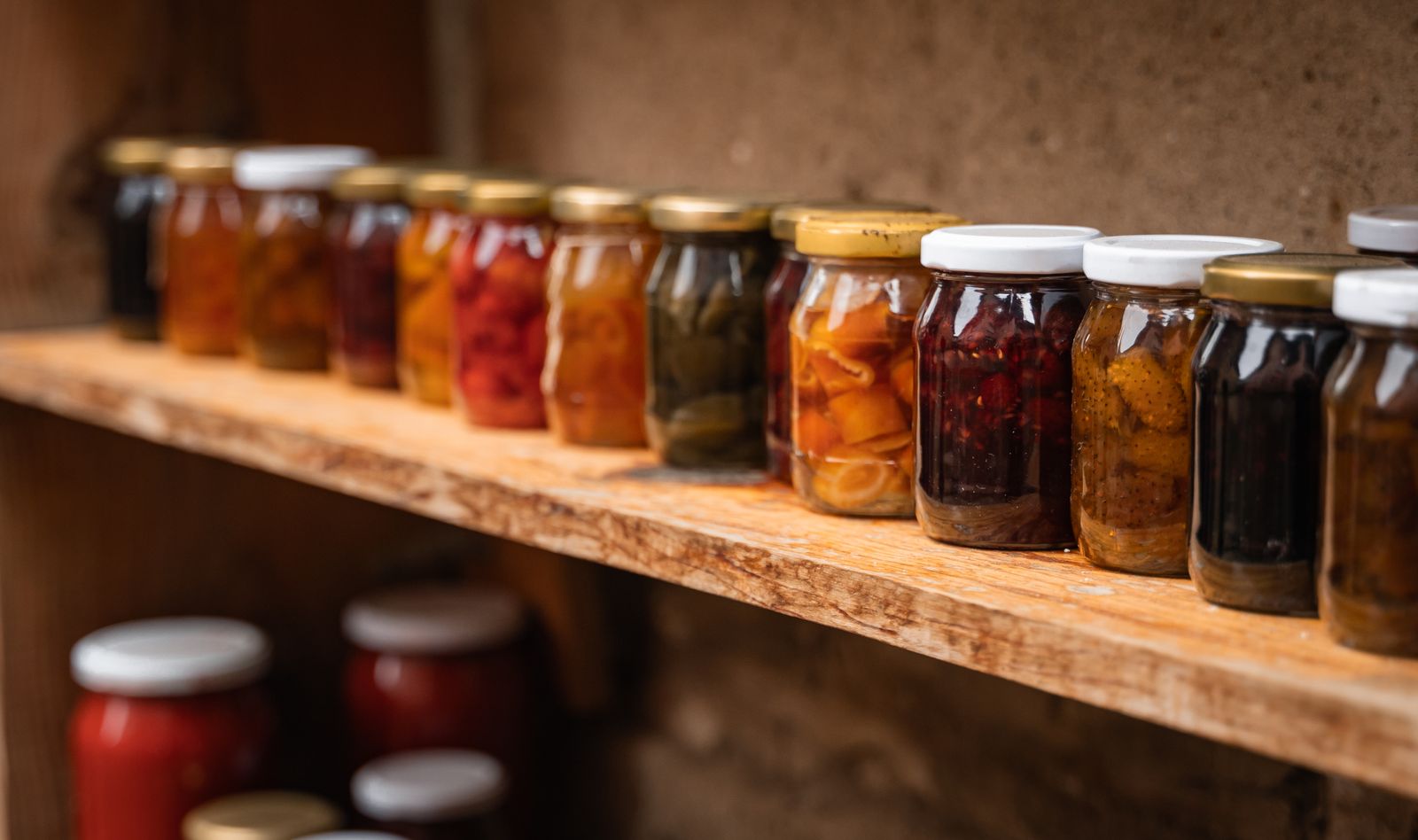
Good storage is where most of a jar's quality is won or lost. NCHFP guidance is to store sealed jars in a clean, cool, dark, dry place, with best quality between 50–70°F. A cool interior cupboard, a dry basement, or a pantry away from heat will serve most households.
Remove the bands first. After jars have cooled for 12–24 hours, undisturbed and upright, take the screw bands off before shelving. A band left in place can hold a failing lid down and hide a broken seal: a lid that has quietly unsealed under a snug band looks exactly like a sealed jar. With the band off, a failed seal announces itself. Removing bands also stops them rusting in place. Storage should be band-free, or with bands only fully clean and dry if they must go back on.
Wash, label, and date every jar. Wash the cooled jars, dry them, and label each with its contents and the date it was canned. That date is how you run rotation, judge the quality window, and identify a batch's sibling jars if one ever gives you reason to wonder. The source guidance is worth bookmarking: NCHFP guidance on storing home-canned foods. As each jar goes onto the shelf, confirm the lid is slightly concave and does not flex when pressed — that is the vacuum holding. A jar that fails that check is not a storage jar at all.
What Shortens a Jar's Life
Heat is the first enemy. Do not store jars above 95°F, near furnaces or hot pipes, in a hot garage or attic, or anywhere an appliance throws off steady warmth. Heat ages food faster — at the extremes, quality can go in weeks or months rather than a year — and sustained heat is hard on seals.
Sunlight is the second: it heats the jars it falls on and fades colour and flavour through the glass. If your only cupboard is sunny, curtains, boxes, or a different cupboard are all acceptable fixes. Damp is the third, and the sneakiest: it corrodes lids, and corrosion breaks seals, sometimes slowly enough that the jar looks fine until the lid is touched. If your basement runs damp, solve the damp or choose another room. For how seals succeed and fail, see why canning jars fail to seal.
Stacking and Rotation
Do not stack jars more than about two layers, and put support between layers — cardboard or a board that spreads the weight, rather than glass resting directly on lids, which can disturb them.
Rotation makes the 1-year rule real. Work first in, first out: new jars to the back, older jars to the front, decided by the date on the label — never by memory. Reach for the front when you plan a meal, and pull forward anything drifting toward the end of its window.
Spoilage Signs: When to Throw a Jar Out
Check every jar before you open it, and again as you open it. Throw the jar's contents out — without tasting, ever — if you find any of the following:
- A bulging lid, or a lid that is not sealed and concave
- A seal that breaks with no resistance, or was already broken in storage
- Liquid that spurts or foams when the jar is opened
- Foam, mould, or growth anywhere in or on the food
- An off odour on opening
- Cloudiness in the liquid that was not there when the jar was stored
The governing rule has no exceptions for thrift or sentiment: when in doubt, throw it out — and never taste to check. Botulism toxin is odourless and tasteless, so your senses cannot clear a suspect jar, and a taste is not a test; it is an exposure. The cost of a thrown jar is a jar. No version of that arithmetic favours tasting.
Notes by Food Type
Not all jars fade at the same pace. As a general pattern, high-acid fruits and tomatoes lose quality faster than low-acid vegetables — their colour and brightness go first, and a jar of fruit at the end of its window will show its age more plainly than a jar of vegetables canned the same week. Plan accordingly: put fruit and tomato shelves on the tightest rotation, and expect them to reward being eaten earlier in the year rather than later. This is a quality pattern, not a safety ranking — the seal and spoilage rules apply identically to every jar, whatever is in it. If you are deciding which method a food even belongs to, our comparison of water bath vs pressure canning lays out that dividing line.
A Jar Found Unsealed in Storage
Distinguish two situations that beginners often merge, because their answers are opposite.
A jar you find unsealed in storage — seal broken at some unknown point since shelving — is a discard. Do not eat the contents, do not reprocess them, and do not talk yourself into "it probably only just happened." You cannot know how long the food has sat unsealed, and that unknown is the whole problem. Discard the contents safely and wash the jar before judging, by its rim, whether the jar itself can serve again.
A jar that fails to seal fresh from the canner is a different case entirely, with options — refrigerate and use it first, freeze it with headspace adjusted, or reprocess it within 24 hours with a new lid for the full tested time. Those options belong to that first day only. If one of your fresh jars has just failed, work through the lid rules and reprocessing guidance promptly rather than shelving the jar and hoping. Storage is for sealed jars. Everything else is decided on canning day.
Frequently Asked Questions
Is a 2-year-old sealed jar safe to eat?
Honestly hedged, because the honest answer has two parts: NCHFP's guidance is that home-canned food is at its best quality within 1 year, and the recommendation stands — plan to rotate and eat within a year. If an older jar's seal is genuinely intact and its storage was good, what you are facing is principally a quality question: expect faded colour, softened texture, and flattened flavour. But "the seal looks fine" must survive the full spoilage checklist above, any doubt at all ends the discussion in favour of throwing it out, and no jar should ever be tasted to settle the question. The standing advice does not change because a jar outlasted it: can what you will use within a year.
Does freezing a sealed jar help it keep longer?
No. Freezing does not improve a sealed jar's keeping, and it puts the jar itself at risk — contents expand as they freeze, which can break the seal or the glass. A properly sealed jar belongs in its cool, dark cupboard. Freezing is an option for the contents of a fresh jar that failed to seal, decanted or adjusted as freezing requires — not a storage upgrade for a sealed one.
Can I store jars with the bands on?
It is not recommended. As explained above, a band left on can hold a failing lid in place and hide a broken seal, and bands stored on jars in a damp cupboard can rust against the lid. Store jars with the bands removed; if a band goes back on for transport, use one that is fully clean and dry, and take it off again when the jar returns to the shelf.
Why did my peaches darken at the top of the jar?
Usually, oxidation and ordinary quality loss rather than spoilage. Fruit at the top of the jar is the most exposed to the air in the headspace, and discolouration there also ties to excess headspace — the more air left above the food, the more darkening you should expect over storage. Darkened tops alone, with an intact seal and no spoilage signs, are a quality note for next season's packing, not a discard on their own. Any accompanying sign from the spoilage checklist — a broken seal, off odour, mould, foam — changes that verdict immediately, and the jar goes out.
Comments
Post a Comment
Play nice — spam and promo links are deleted.